Should you really create a SIP for riding gear? Feat Sourav Singh
Story by Priyanka Rathod · Featuring Sourav Singh
Published 31 October 2026
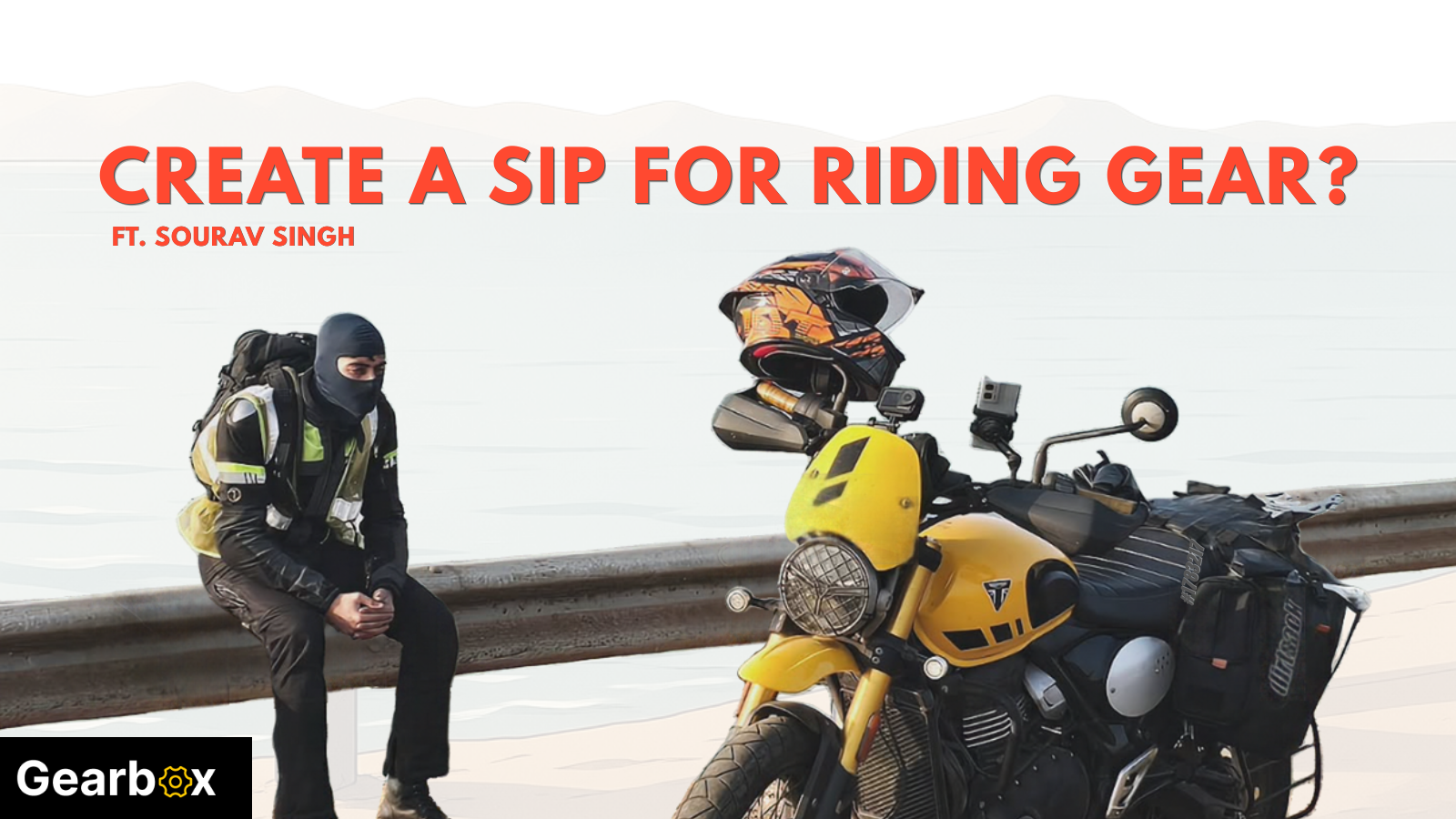
“Don’t bankrupt yourself, but don’t compromise either,” Sourav emphasised throughout our chat.
Thanks to easy financing options, access to the internet, homegrown brands, and the ever-growing influence of social media, young India is now empowered to afford quite a lot of what the world has to offer these days. The motorcycle industry, too, has grown by leaps and bounds, with middle-class India welcoming some of the most premium machines into its garages and spending considerably on their upkeep.
While we have collectively noticed a shift in what the Indian rider today aspires to own and experience, there is an unfortunate miss. Something that is just as important as the motorcycle.
Rider’s S.A.F.E.T.Y
The safety we are discussing here goes beyond a rider’s skill. It’s an extension of the motorcycling experience, and one that is still severely overlooked. Yep! We’re talking about riding gear.
Sourav has expressed his disdain, watching riders on Z900s zip past on the streets wearing helmets of negligible quality, or worse, no helmets at all. Which begs the question: Is riding gear still considered merely an add-on rather than a necessity?
Well…let’s dig into it.
I first met Sourav Singh during a chance encounter at India Bike Week 2025 in Panchgani. A year later, Gearbox happened, and he was kind enough to offer his thoughts on the current state of things in the motorcycle industry. Neither of us claims to be experts, but that shouldn’t stop us from talking about things that matter.
One of the things we discussed was the cost of riding gear. It is no secret that putting together a decent set-up can be expensive. For someone who has just purchased a motorcycle, the prospect of spending another substantial amount on a helmet, jacket, gloves, riding pants and boots can be daunting.
Sourav's argument was that price shouldn't be the only deciding factor. He does not advocate buying the most expensive gear on the market, but he is equally clear that choosing something simply because it is cheaper isn't always the smartest decision.
He recalls trying on racing leathers, comparing options from two brands: one more affordable and another from Alpinestars. Even though the Alpinestars Missile wasn't the top-spec GP Force suit he had initially wanted to try. It did make him realise that there is a tangible difference between the quality of products, and sometimes spending a little more can make a meaningful difference to your experience.
He also made a similar point when we spoke about helmets. A helmet from SMK, for instance, could weigh around 2 kg, whereas options from brands such as KYT and HJC offer alternatives that may be lighter and better suited to certain riders. He also brought up the difference between Asian and European helmet fits, particularly around the temples. A helmet that fits one head shape comfortably may not necessarily work for another.
Unfortunately, riders commonly spend ₹5,000 - 6,000 on a helmet and stop there, even if extending their budget by another ₹3,000 - 6,000 could open up more comfortable options. His advice wasn't to buy the most expensive gear available. It was to understand where spending a little more could make a meaningful difference.
The same applies to specialised equipment. Sourav brought up knee braces as an example. A pair from Leatt could set you back approximately ₹30,000, but for someone who spends considerable time riding off-road, it could be a worthwhile investment. It is definitely a subjective approach.
He even suggested considering an EMI if it meant getting a helmet that offered a noticeably better fit and comfort. His argument was simple:
“If the difference between two helmets is significant enough to affect your comfort over the long term, it may be worth stretching your budget.”
Of course, not everyone needs a pair of knee braces or a set of racing leathers. That's precisely the point. Your purchases should reflect the kind of riding YOU actually do.
But what if you're just commuting?
This is where the conversation gets interesting, especially in the Indian context.
Let's be honest. Riding in India is not always a pleasant affair. Heat, humidity, traffic and the sheer unpredictability of our roads can make wearing a complete set of riding gear feel like a task in itself.
For someone riding a motorcycle to work every day, putting on a jacket, gloves, riding pants and boots before stepping out may seem impractical.
Sourav brought up armoured base layers as one possible way of making protective gear more accessible to everyday riders. Instead of wearing a conventional riding jacket over your clothes, you could wear an armoured shirt underneath a regular shirt or hoodie. The idea is to have protective armour close to the body while using an outer layer to provide abrasion protection. Some brands worth looking at: Pando Moto and Rynox
It's an interesting approach, particularly for riders who find conventional jackets uncomfortable in the heat. Sourav suggested that one could even pair a base layer with something like the Royal Enfield Shacket.
We also discussed riding footwear that doesn't necessarily look out of place once you reach your destination. Sourav mentioned the Trip Machine riding sneakers and footwear from Clan which offer alternatives for riders who want something that works with everyday clothing.
Of course, there is a distinction between making gear more convenient and treating convenience as a substitute for protection. A casual-looking riding shoe, for instance, is not automatically equivalent to a proper motorcycle boot.
Interestingly, Sourav was less convinced about the necessity of riding pants for every short city commute. Of course, this is where the familiar All The Gear, All The Time (ATGATT) argument enters the conversation.
But this is his personal assessment, rather than a universal safety recommendation. The broader question remains: how do we make protective gear practical enough that riders are more willing to use it?
Because if the only options we present to a new rider are an expensive full riding suit or nothing at all, we are missing an opportunity to get more people started.
What does a practical riding set-up look like?
I was curious to know whether Sourav followed the same philosophy himself. After all, it's one thing to recommend gear and quite another to decide what you're going to wear when you're running late for work.
For short commutes, Sourav usually wears just a helmet and gloves. If he's travelling beyond roughly 10 kilometres, he'll add his Forcefield base layer and wear a regular shirt over it. For longer rides, he says it depends on the kind of riding and the individual.
We spoke about ventilation, too. Sourav shared his experience with different jackets and how ventilation, or the lack of it, influenced his choices. He recalled his experience with a (now-discontinued) Rynox Noctex jacket, mentioning its retroreflective liner but also his concerns about ventilation in contrast to the LS2 Jacket with ventilation zips, which offered a different experience.
A jacket might have all the features you want, but if wearing it in Indian summers becomes unbearable, how often are you going to reach for it?
This is where the conversation around Indian and international brands becomes interesting. Sourav acknowledged that Indian brands have come a long way in terms of comfort and features, but he still prefers certain international options for more specialised riding.
He brought up the Rynox Dune Neo off-road jacket in comparison with Leatt's Enduro 4.5 and 5.5 offerings. Similarly, while he was comfortable considering Indian brands for generic commuting gloves, he preferred international options for off-road gloves.
His preferences weren't necessarily about choosing one country of origin over another. They were about the kind of riding he went for and the demands that came with it.
Your gear requirements will evolve with you. 100%
This brings us to something I think many riders overlook when they first get into motorcycling.
We often approach buying riding gear as a one-time exercise. We buy a helmet, perhaps a jacket and gloves, and assume we've ticked the box. But motorcycling is rarely that static.
“You might begin with a 150-250cc motorcycle and eventually move to a 600cc or even a 1000cc machine. As your skills develop and your riding changes, your gear requirements will change, too.” says Sourav.
He also spoke about having different footwear for different kinds of riding: a pair for the track, another for off-road use, and something more practical for everyday commuting or touring.
It may sound excessive to someone who is just starting out, but it makes sense when you consider that specialised gear is designed around specific riding demands. Your gear collection doesn't have to be complete on day one. It can grow as your riding experience, interests, and requirements evolve.
So, should you really create a SIP for riding gear? Is that sane financial advice?
Sourav swears by it! And I agree with him.
We tend to plan our motorcycle purchases, save for accessories, budget for servicing and set aside money for our next big ride. But how often do we consciously set aside money for the equipment that protects us while enjoying that motorcycle? Not often enough!
Sourav's suggestion was to start with whatever you can reasonably afford, rather than waiting until you have enough money to buy an entire setup. Prioritise the essentials, make informed purchases, and gradually upgrade as your riding needs change.
He also shared a little about his own buying journey. Interestingly, (and very much like me), Sourav bought his first helmet around two months before purchasing his motorcycle. His family and friends found it rather unusual. After all, why buy riding gear before you even own the bike? But he had already made up his mind.
He started with a helmet, followed by gloves, riding pants and boots. Over time, his collection grew. It wasn't a one-time purchase. Instead, it was a gradual process.
And perhaps that's the best way to look at riding gear. You need to start somewhere, understand what you need, and make room for those purchases in your financial planning.
A separate SIP may not be a literal investment plan for everyone, but the thought behind Sourav's suggestion is worth considering. If you know that better gear is something you will eventually need, why not plan for it instead of treating it as an unexpected expense?
I think the Indian motorcycling landscape is at an interesting point. We're increasingly willing to spend on bigger motorcycles, better accessories and experiences that were once considered out of reach. There's no reason why our approach to riding gear shouldn't evolve alongside that.
Sourav's suggestion of creating a separate SIP for riding gear makes sense because it changes the way we think about the expense. Instead of looking at protective equipment as something we buy when we have money left over, perhaps we should start treating it as part of the cost of being a motorcyclist.
After all, the riding experience isn't complete without considering the person commanding the motorcycle.
____________________________________________________________
Written by Priyanka Rathod, Founder & Curator, Gearbox